
Where EDCF Intake Moves
The Reception and Diagnostic Unit is part of the Kansas Department of Corrections intake and classification process at El Dorado Correctional Facility. Adult men entering state custody can be assessed there before assignment. A move away from the unit will often be a transfer to the KDOC institution selected for the sentence, custody level, programs, and operational needs. The move ends the reception placement, but it does not end incarceration.
Less commonly, the public record may show a later transition to parole, conditional release, postrelease supervision, or final discharge. Those are distinct outcomes. Community supervision means the person is outside prison but remains subject to KDOC authority. Final discharge generally means the state sentence and its supervision have ended. KASPER status and movement fields, not the mere loss of an EDCF location, establish the difference.
Confirm EDCF Intake Status
Use the official KASPER offender search. Search by KDOC number when known because it is the most exact key. A name search should be checked against date of birth, physical description, conviction county, offense, and case number. Open the detail and read the latest location, movement date, custody or supervision level, and parole-office or discharge entry together.
- Verify the identity and KDOC number.
- Locate the reception-unit movement in the history.
- Read the destination on the next movement.
- Treat another prison as a transfer, not release.
- Look for community-supervision or discharge wording before reporting release.
KDOC says KASPER updates daily except weekends. A movement late Friday or during a weekend may not appear at once. Save the access date and recheck on a weekday. The Butler County release search overview helps keep this state channel separate from the Sheriff's current county-jail roster.
EDCF Intake Movement Records
KASPER can include current location, facility movements with dates, KDOC number, conviction information, anticipated release date, custody or supervision level, parole-office location, and a photograph. For the reception function, movement history is especially important. A single current location may hide the intake step that explains why a person appeared briefly at EDCF and then showed another prison.
For a public state record beyond KASPER, send a focused request to the KDOC records custodian. Identify the KDOC number, name, approximate reception period, and the precise movement or release fields sought. Ask for an electronic copy and separable public portions if information is withheld. Kansas open-records guidance calls for action by the end of the third business day, though production may take longer and reasonable fees can apply.
El Dorado Correctional Facility
1737 SE U.S. Highway 54
El Dorado, KS 67042
KDOC Sentence Computation
785-296-3317
EDCF Sentence-Credit Context
The Kansas Legislature's older-sentence good-time statute is one source showing why sentence law must be matched to the actual case rather than inferred from a reception date.
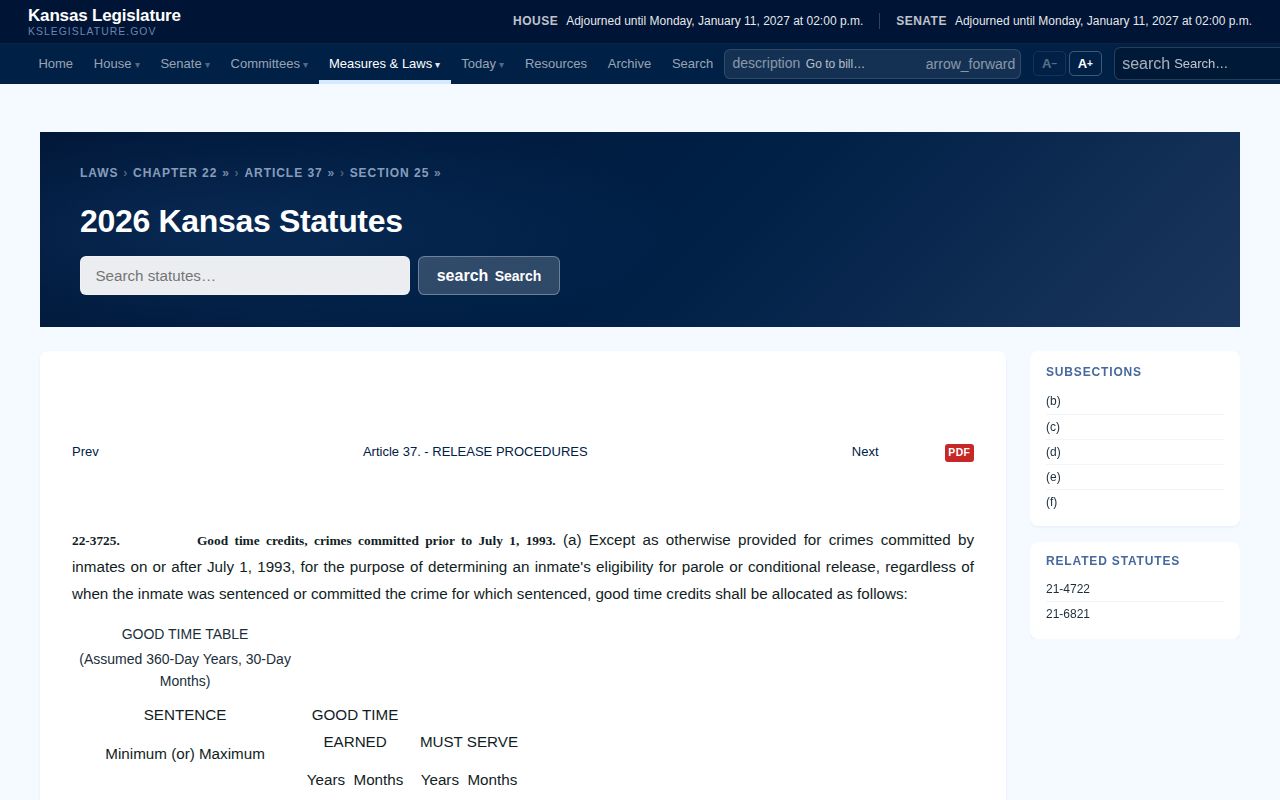
The statute image reinforces that an intake date and an anticipated release field do not reveal the full calculation. Modern guideline sentences, older indeterminate sentences, credits, and later changes use different legal rules.
EDCF Anticipated Release Date
KDOC calls the forward-looking KASPER field the “anticipated release date.” It is an estimate, not a fixed departure appointment. Good-time and program credits, forfeitures, sentence structure, court action, and lawful recalculation can change it. Reception staff classify people entering the system; they do not provide a durable public promise that a person will leave on the displayed date.
Questions about one person's calculation should go to KDOC Sentence Computation at 785-296-3317. Provide the KDOC number and case. The Release Date Lookup gives more context on credits and date changes. A family planning around a date should confirm it with KDOC rather than reverse-engineer the sentence from a web page.
EDCF Community Supervision Results
A community result can name the supervising parole office. Parole is supervised release for an eligible sentence, while postrelease supervision is a required community phase after the prison portion of many modern sentences. Conditional release and compact supervision are other labels that may appear. None means that the conviction vanished or that the entire sentence necessarily ended.
The current KDOC contacts page lists the El Dorado Parole Office at 226 W. Central Avenue, Suite 310, El Dorado, Kansas 67042, telephone 316-619-8726, serving Butler, Elk, and Greenwood Counties. Check the live parole-office listing because offices can change. Use the KASPER office field before assuming that El Dorado supervises a particular person.
EDCF and BCDF Records
Butler County contains both a state prison and a county jail. Their El Dorado locations make confusion easy. The Reception and Diagnostic Unit is within the KDOC system. Butler County Adult Detention Facility is operated by the Sheriff for local and outside-agency detention. A Sheriff roster cannot confirm an EDCF release, and KASPER is not an archive of ordinary county bookings.
A person may leave BCDF for KDOC intake and then appear at the Reception and Diagnostic Unit. That is a transfer into state incarceration. Later movement from reception to another KDOC prison is another transfer. Only a community-supervision or discharge record supports a state-prison release conclusion. This sequence should be stated one agency at a time.
Limits of EDCF Intake Searches
A missing KASPER result remains inconclusive. Name variation, mistaken identity, weekend lag, record restrictions, or exclusion from the public scope can affect the search. KDOC says interstate-compact inmates sent to Kansas are excluded, and public names may be removed after an overturned conviction, expungement, or executive clemency. Use the KDOC number whenever possible.
Court records explain the sentence and later orders. The Kansas district-court records guide provides the public portal and courthouse-terminal route. Some material is sealed, expunged, juvenile, or otherwise restricted. KASPER reports the correctional movement, KDOC calculates the sentence, and the court controls its judgment. Keeping those roles separate produces the most reliable account.
EDCF Classification Versus Discharge
Reception classification answers where a person should serve the sentence and what custody or program needs apply. Discharge answers whether KDOC authority under that sentence ended. The events can be far apart. A short stay in reception followed by a new facility is normal movement through the system, while a discharge should be supported by the current KASPER status or an official KDOC record.
K.S.A. 22-3722 concerns final discharge after qualifying service on parole or postrelease supervision. It should not be attached to an intake transfer. Ask for the movement entry when the question is where the person went, the sentence calculation when the question is when release may occur, and the discharge record when the question is whether state supervision ended.
Build an EDCF Intake Timeline
Begin the timeline with the court commitment and KDOC number. Next record the KASPER arrival or movement into EDCF reception, the following destination and movement date, and the current custody or supervision level. Compare the conviction county and case number to the sentencing record so a same-name result does not become the wrong person's history. Save the date on which each dynamic record was checked.
If the next location is a KDOC prison, describe an institutional transfer. If the result names a parole office or community status, describe release from prison to supervision. If it says discharged, check the sentence and later movement entries and seek the official discharge record when stronger proof is needed. This sequence prevents a gap between two locations from being mislabeled as a community release.
EDCF Supervision Violation Records
A person who previously left prison can return to KDOC custody after a supervision warrant or violation process. K.S.A. 75-5217 addresses violations and warrants and defines absconding in this context. Absconding generally means failing to remain under supervision as required. It is a supervision status, not automatic proof of a new conviction. The current KASPER movement and the official violation record should control the description.
The Kansas Legislature's supervision-violation statute provides the legal context.
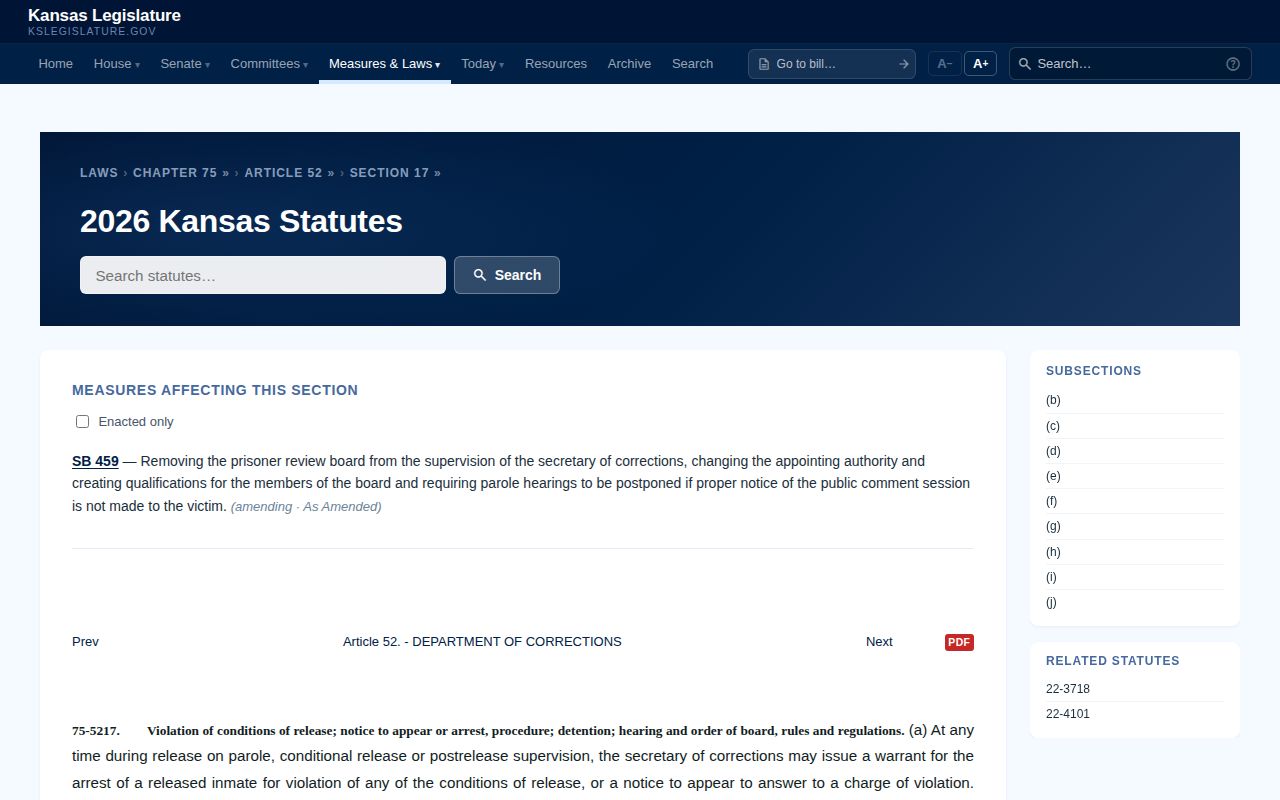
The statute view supports checking the active warrant, custody event, and later order rather than treating a return to EDCF as if no earlier prison release occurred.
EDCF Public Record Scope
KASPER covers people sentenced to the Secretary of Corrections since 1980 who are incarcerated, under post-incarceration supervision, or discharged. It can retain a long correctional history after the reception stay ends. It is not a county-jail roster, and KDOC says people sent to Kansas under the interstate compact are excluded. Public names may also be removed after expungement, an overturned conviction, or executive clemency.
These limits make a no-result search inconclusive. Recheck spelling, use the KDOC number, consult the sentencing court, and contact KDOC when commitment is known. A legally restricted public absence is not evidence that the reception event never happened. State only what the named source shows and avoid broad claims about current freedom.