
Where EDCF Releases Go
El Dorado Correctional Facility is operated by the Kansas Department of Corrections. It is not a Butler County Sheriff's jail. A resident leaving EDCF may move to another KDOC institution, enter parole or postrelease supervision, or reach final discharge from the state sentence. Parole is supervised community release under rules that apply to eligible sentences. Postrelease supervision follows the prison portion of many modern Kansas sentences. Final discharge means the KDOC sentence and supervision have ended, subject to the individual record.
An EDCF gate departure alone does not establish which result occurred. KASPER movement history and current status are the public starting points. A new prison location normally reflects an internal transfer. A parole-office location or community-supervision status supports release from prison with continuing KDOC authority. A discharged status should be read with the sentence and movement entries. The county roster is irrelevant to these state movements.
Confirm an EDCF Release
Open the official KASPER search, read its disclaimer, and search by KDOC number when available. That identifier is more precise than a name. If using a name, compare date of birth, physical description, conviction county, offense, and case number before opening a result. Record the exact current status, location or supervising office, movement dates, and release fields, along with the date checked.
- Confirm that the person was committed to KDOC, not held only at BCDF.
- Match the identity and KDOC number.
- Read the newest movement and present location together.
- Distinguish another institution from a parole office or discharge.
- Recheck after a weekend because KDOC reports weekday updates.
The Butler County released-inmate guide compares state and local custody. KASPER covers people sentenced to the Secretary of Corrections since 1980 who are incarcerated, under post-incarceration supervision, or discharged. It does not preserve ordinary county-jail releases for people never committed to KDOC.
EDCF Records and Contacts
The official KDOC EDCF page is the source for current facility contacts and visiting information. Its published location is 1737 SE U.S. Highway 54, El Dorado, Kansas 67042. Because contact details can change, verify the live page before sending mail or planning a visit. The general prison contact should not be asked to estimate a sentence from a web result.
For a specific date calculation, KDOC lists Sentence Computation at 785-296-3317. Provide the KDOC number and case information. For a public offender, release, or discharge record beyond KASPER, direct a focused request to the KDOC records custodian. Ask for the status or movement record that answers the question. A certified judgment or sentencing entry comes from the court clerk, not the prison.
1737 SE U.S. Highway 54
El Dorado, KS 67042
KDOC Sentence Computation
785-296-3317
EDCF KASPER Record Fields
KDOC says KASPER can include a person's name, KDOC number, physical description, photograph, conviction description, county, case number, current location, and facility movements with dates. It can also display custody or supervision level, parole-office location, disciplinary findings, and an anticipated release date. These fields create a timeline, not just a yes-or-no locator result.
Read the anticipated release date cautiously. KDOC uses that exact label. It is forward-looking and can change with the sentence structure, good-time credits, program credits, forfeitures, court action, or other lawful recalculation. It is not a promised pickup date. The Release Date Lookup explains the distinction and routes calculation questions to Sentence Computation.
EDCF Discharge Record Example
The Kansas Legislature's final-discharge statute helps distinguish completion of supervision from the earlier physical prison release.
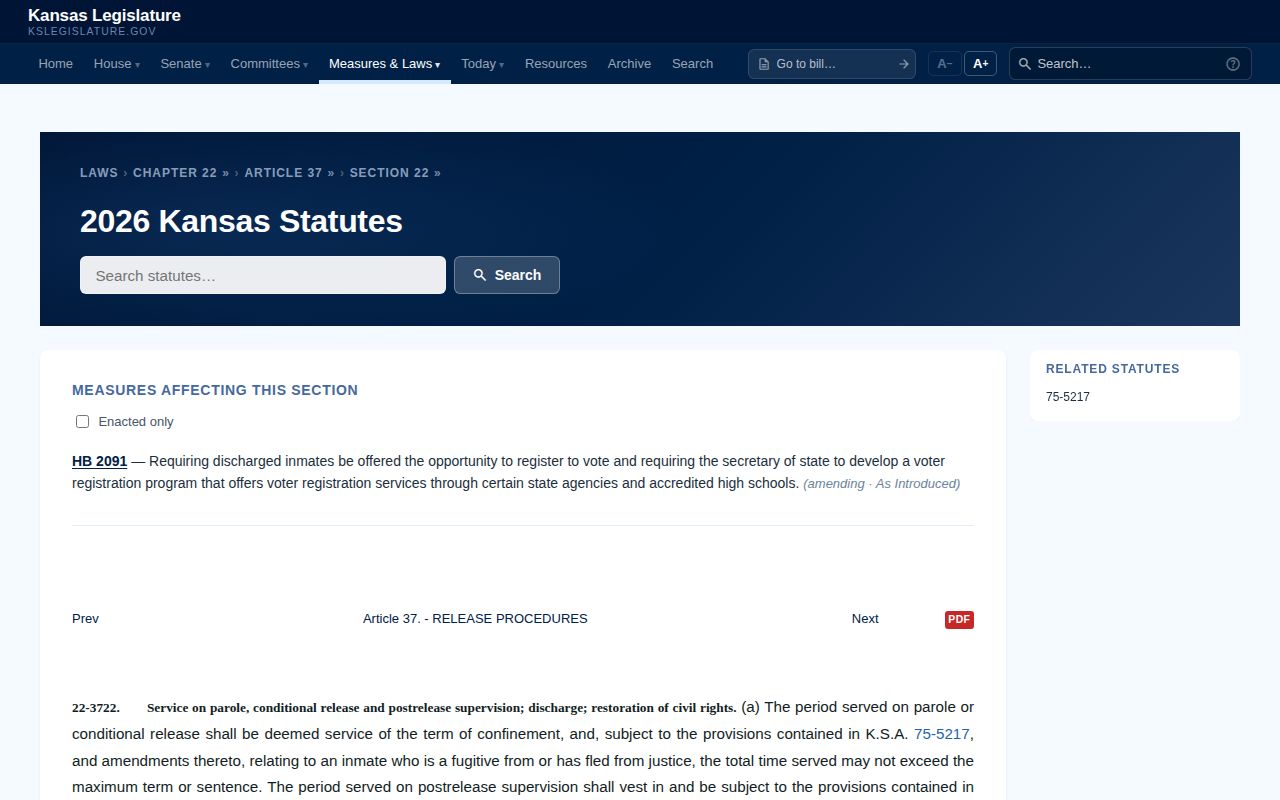
The statute view supports checking for a discharge certificate or official KDOC discharge record instead of treating a past prison movement as proof that every part of the sentence ended.
EDCF Post-Release Supervision
A person may leave EDCF and remain under KDOC supervision. KASPER can identify parole, conditional release, postrelease supervision, or a compact supervision status and may name the parole office. The current KDOC contacts list places the El Dorado Parole Office at 226 W. Central Avenue, Suite 310, El Dorado, KS 67042, telephone 316-619-8726, serving Butler, Elk, and Greenwood Counties.
The KDOC parole-services contacts should be checked for the latest office listing.
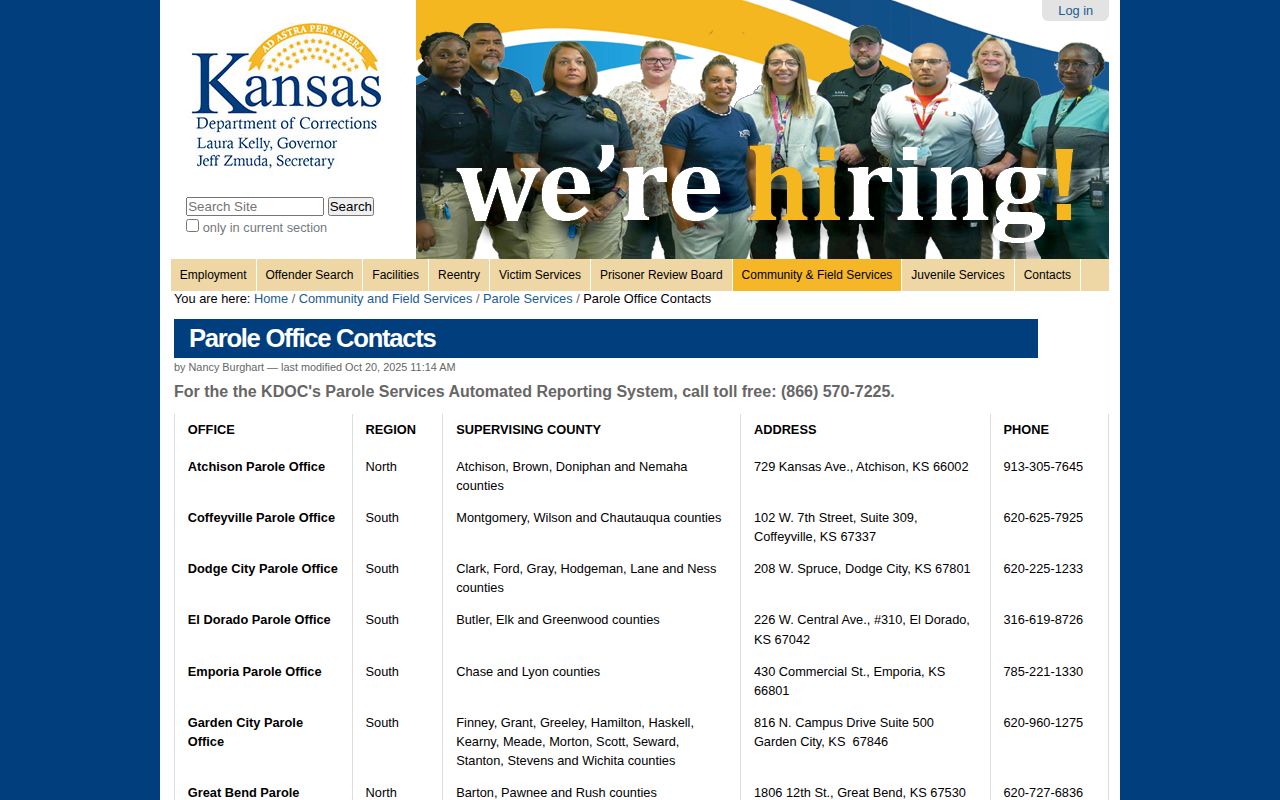
The office listing connects a KASPER supervision result to the agency that can confirm reporting location, while the Prisoner Review Board and court records address different parts of the legal history.
EDCF Transfer Is Not Release
EDCF performs reception and diagnostic work as well as prison operations. That makes internal movement common. If KASPER changes from EDCF to another KDOC facility, the person remains in state custody. “In transit” or a movement entry also should not be rewritten as community release. Wait for a community-supervision, parole-office, or discharge entry and confirm uncertain changes with KDOC.
This distinction is the local county-jail/state-prison naming trap. A transfer from Butler County Adult Detention Facility to EDCF ends Sheriff custody but begins or continues state incarceration. A transfer from EDCF to another prison ends the local placement but not KDOC custody. State and county records must be read in sequence.
Limits of EDCF Searches
No KASPER result does not prove that no record exists. KDOC notes that interstate-compact inmates sent to Kansas are excluded, updates pause on weekends, and names may be removed after an overturned conviction, expungement, or executive clemency. Name variations and identity mismatches also matter. Search with the KDOC number and consult the court when a state commitment is known.
A release from prison is not an acquittal and does not erase the conviction. Likewise, final discharge is distinct from expungement, the legal process that may restrict public access to qualifying records. Use source-specific language: KASPER reports a status, KDOC calculates the sentence, and the court controls its orders.
EDCF Credits and Date Changes
K.S.A. 21-6821 governs good-time and program credits for modern Kansas guideline prison sentences. The research documents a fifteen-percent good-time framework for many covered sentences and twenty-percent categories for certain severity levels and cases, with program credits also available under the statute's limits. The common shorthand that a person serves eighty-five percent does not explain every Kansas sentence. Offense date, severity, sentence terms, earned credit, forfeiture, and later action all matter.
Older crimes use different provisions, including K.S.A. 22-3725 for specified pre-July 1993 sentences. Parole eligibility under K.S.A. 22-3717 is also different from a modern mandatory postrelease structure. That is why the anticipated release date should be taken from the current KDOC record and individual questions should go to Sentence Computation. A page visitor should not calculate a guaranteed exit date by subtracting a flat percentage from the court sentence.
EDCF Parole Decision Trail
The Kansas Prisoner Review Board's public-comment schedule and parole-hearing materials explain the process, but a name on a monthly list is not proof of release. Public comment comes before the hearing. The Board may grant, deny or pass, continue the matter, or act in another documented way. A release plan, legal holds, and later KDOC processing can remain after a favorable decision.
No official public individual Board decision-search interface was found in the research. For a particular decision, the practical path is a focused KORA request to KDOC or the Board, followed by later KASPER status and movement. The official public-comment hub can change monthly, so record the visible schedule date. Do not assign an aggregate annual outcome category to a person without that person's official record.
EDCF Notification Channels
KDOC operates an official Victim Services notification registration for eligible people when the named person is in a KDOC facility or under KDOC supervision. The form lists 1-866-404-6732 and VictimWitness@doc.ks.gov. It expressly differs from county-jail or community-corrections-only coverage. KASPER remains the public status and sentence-data source, while notification registration serves prospective notices.
Kansas VINELink is another notification route, and the matched agency record controls what it covers. Neither service replaces the official movement, release, or discharge record. Confirm an alert with KDOC, especially when it may describe a transfer or when timing matters. A delivery failure or missing search result cannot establish that the person remains confined or has been released.